Press
What has been written about the records
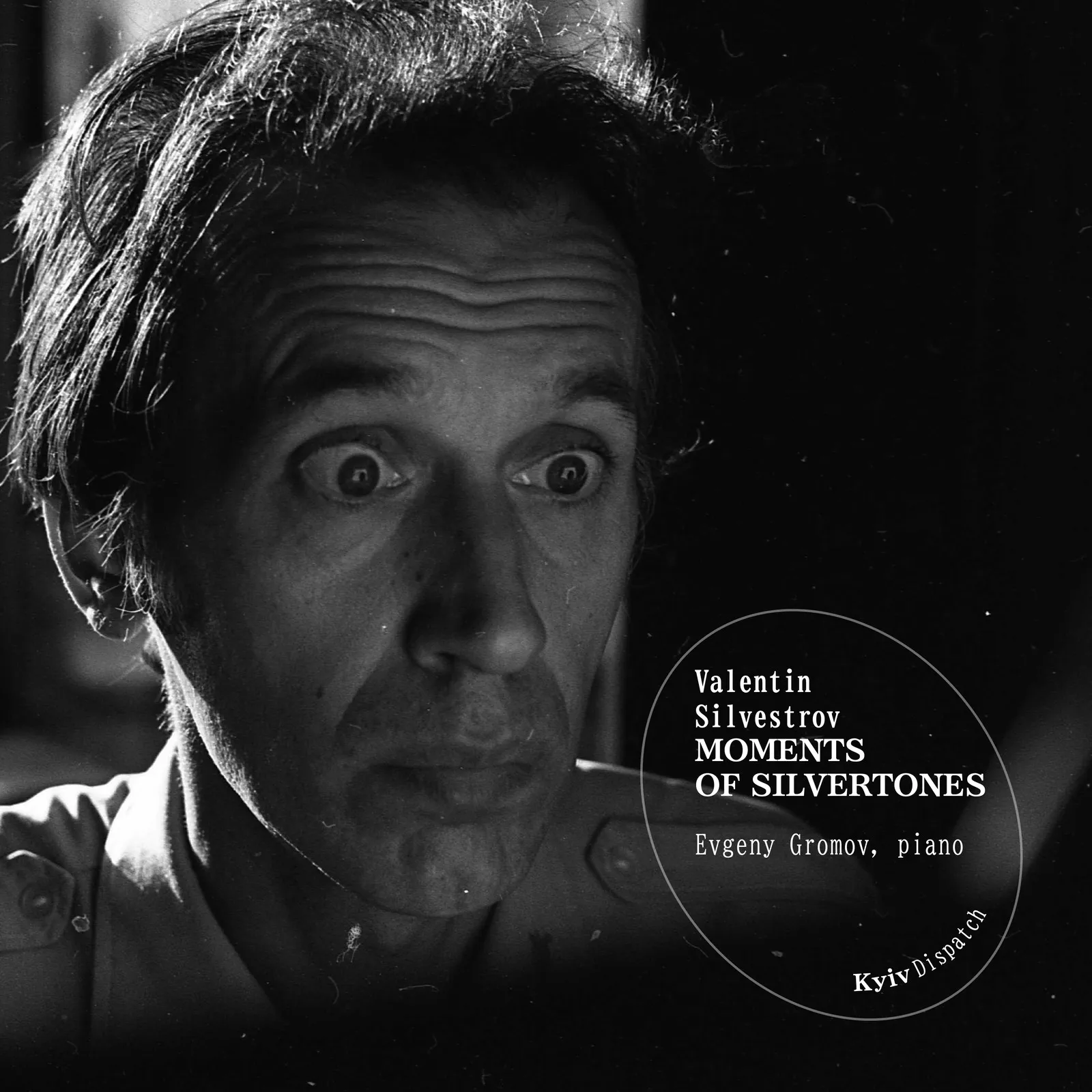
“The music and commentary coalesce to place Moments of Silvertones among the most satisfying Silvestrov piano albums to date”
Point of Departure — Marc Medwin · Original
Read the reviewClose
With each usage, or misusage, of the phrase “Avant Garde,” a box is built and another dismantled. The resultant inclusions and exclusions leave no room for permeability, particularly unfortunate where the music of Ukrainian composer Valentin Silvestrov is concerned. The common story is that he turned away from the Avant Garde he and several of his compatriots pioneered, but Moments of Silvertones, performed by pianist Evgeny Gromov on the Kyiv Dispatch label, demonstrates that there is much more unity to Silvestrov’s music than first meets the ear. To support this vantagepoint, this 2024 recording, released as a 2-LP set or download in anticipation of Silvestrov’s 90th birthday in 2027, features works spanning the years 1961-2006, neatly divided by 1975’s second piano sonata.
While Alexei Lubimov is usually the pianist credited with bringing international recognition to Silvestrov’s music, Gromov has long championed the composer, performing a memorable recital in 1998 for his 60th birthday. After Russia’s 2022 invasion of Ukraine, when Silvestrov fled with other refugees and took up residency in Berlin, Gromov, who remained in Kyiv, began a series of recitals at the vacant Khanenko Museum. The programs lasted over a year and expanded into a space for dialogue with the composer over skype meetings. Silvestrov’s involvement affords these traversals both authority and urgency.
The first LP represents Silvestrov’s early period, when his allegiance to other gamechangers like Boulez, Messiaen, and Dutilleux was most apparent. Unlike Penderecki, Silvestrov’s soundworld exhibited a degree of introversion, even at its atonally spikiest, as with Five Pieces (1961). It twitters like the insects informing Scriabin’s final piano sonata, and, like Boulez, exhibits a coloristic beauty too infrequently associated with anything lacking tonic and dominant. The final piece from Schoenberg’s opus 19, the air-from-other-planets tribute to Mahler composed in 1911, is an obvious precedent for the mystical sustains and long pauses as tones waft and alight, but the brief centers Silvestrov evokes demonstrate a post-Wagnerian approach to the ever-present tonal question. Even in 1961, implication imbues Silvestrov’s take on serial procedure, a fact Gromov emphasizes to gorgeous effect. His instrument and a full recording allows him to caress each sonority, demonstrating the composer’s divergence from the Webernian path. In the retrospect, this program allows the two seemingly diatonic harmonies at 4:42 to point the way toward a future less about disjuncture than distillation and refinement.
While certainly not Silvestrov’s initial foray into tonality – the first string quartet, much of it centered around G major, preceded it – the second piano sonata (1975) bridges many ideological gaps. The two chords at 0:19 of the one-movement piece are harmonically sequential, despite their context, and their repetition and transposition beginning at 0:40 triggers a small-scale version of the memory experience that would become so important to the composer in later years. In fact, the composer coming most to my mind is Medtner, so unified are form and structure, despite a universe of sonic diversity. Gromov’s pedaling and resultant melodic and harmonic contrasts are breathtaking in their subtlety. His is a tighter rendering than the Lubimov recording for Erato, from which I learned the piece, extremely important given the radical shifts in perspective and sound as the movement nears conclusion. Palms in direct contact with the bass strings, muting, harmonics in motion, and intersecting registral planes roar with a restrained power I’ve heard in no other performance, but the C-major section near the end teems with subdued life and sublimated energy.
The Kyiv Dispatch production exceeds Erato’s in power and clarity, and even Simon Smith’s version, a full if slightly distant Delphian piano capture, now seems slightly anemic.
The two-chord sequence, appearing throughout the sonata and at its conclusion, is prophetic, not in and of itself but in the layered ways Silvestrov approaches ideas associated with memory. Reminiscence and its creative associations take on special import in Silvestrov’s recent music, so much so that his bagatelles begin with a new opus 1. This could not be expressed better, or more poetically, than by album producer Sasha Andrusyk in her liner notes. She calls Silvestrov’s compositions from the 2000s and beyond a “late language of memory, postlude, and distance.” Silvestrov crafts moments of reference even as they fade into something like impalpability. Yes, the tonal implications nascent in the second piano sonata are foregrounded here, but the language is diatonic mainly in a post-Wagnerian sense, that is of parenthetical center rather than of completely established framework. The first bagatelle of Opus 1 moves from C major to E major before the opening material repeats, doing so directly, abruptly returning to the original key. The piece ends similarly but after a sustain in A flat, conjuring shades of late Liszt. Moments demonstrates the same modulatory third-based relationships, and the motivic material is similarly aphoristic.
Miraculously, Gromov plays these later miniatures so that they are of a piece with Triad and the second sonata, instants caught in the vicissitudes of time and nostalgia. Gromov’s genius is that he plays all of the music with an eye toward the seeming opposites of composition and improvisation, not all that differently from the composer’s pianism, which can be heard on his Bandcamp page. Gromov, who has recorded much music of the Ukraine Avant Garde, is the perfect pianist for the project, and I hope there will be more to follow. It would be unreasonable to hope for a complete piano works set, but there would be no one more qualified and better suited to approach it. The music and commentary coalesce to place Moments of Silvertones among the most satisfying Silvestrov piano albums to date.
Point of Departure — Marc Medwin · Original
“The divide between his Modernist early work and the richly melodic Bagatelles seems to dissolve”
Bandcamp Daily — Peter Margasak · 6 August 2026 · The Best Contemporary Classical Music on Bandcamp, July 2026 · Original
Read the reviewClose
In March of 2022 the revered, prolific Ukrainian composer Valentin Silvestrov, now age 88, fled his native Kiev after Russia launched its war of aggression—a disturbing turn of events for a man whose career emerged during the Soviet era. Later that year, pianist Evgeny Gromov began to perform the composer’s piano music in the Khanenko Museum—which ordinarily houses Ukraine’s most important collection of European art—every few weeks, although some performances were cut short by the wail of air-raid alarms. The pianist shared recordings of the performances with the composer—they’d first met in the mid-1990s, and Gromov gave a celebrated concert of Silvestrov’s music for the latter’s 60th birthday in 1998. The process led the pianist to make the present recording, which spans a huge chunk of the composer’s career, beginning with rarely heard pieces from the early 1960s and concluding with his Bagatelles from the early 21st century. Time and mortality weigh heavily on the album, especially when one considers that Silvestrov might never return to his homeland—he’s been in Berlin since the invasion—and the divide between his Modernist early work and the richly melodic Bagatelles seems to dissolve. The starkness of the early works resonates in fresh ways given the ongoing threat to Ukraine, while the sentimental beauty and airy contemplation of the late work feels different now from when they arrived two decades ago.
Bandcamp Daily — Peter Margasak, 6 August 2026 · Original
“Evgeny Gromov’s undoubtedly profound playing is characterized by a delicate touch and the subtle use of the pedals. He lifts the elegiac veil and looks to see what lies beneath”
Pizzicato — Marcelle Weis · 20 July 2026 · Original
Read the reviewClose
Ukrainian pianist Evgeny Gromov is considered one of the foremost experts on the piano works of Ukrainian composer Valentin Silvestrov. His album ranges from early modernist avant-garde works to the later, more accessible bagatelles and is being released as a double vinyl LP and digitally by Kyiv Dispatch, a Ukrainian label specializing in experimental and new music.
It is precisely these early, rarely heard works that make this recording so interesting. They may reveal aspects of Silvestrov’s music that are still little known or even unknown to many music lovers, who may be familiar only with his late, personal style.
Evgeny Gromov’s undoubtedly profound playing is characterized by a delicate touch and the subtle use of the pedals. Since virtuosity is not a prerequisite for interpreting these works, only a performer who possesses the emotional maturity for an expressive and finely balanced performance can truly succeed.
It takes a great deal of inner strength to present this music—whether the composer’s early or late works—as more than just dreamy, misty, and unhurried music. And Gromov undoubtedly possesses that strength. He lifts the elegiac veil and looks to see what lies beneath, thereby keeping the listener’s interest alive.
Praise is also due to the recording team: others have shrouded Silvestrov’s piano music in a misty, reverberant sound. That is not the case here. The sound is clear, present, and unadulterated.
Pizzicato — Marcelle Weis, 20 July 2026 · Original
“All of the performances here by Evgeny Gromov are beyond reproach. Five stars: an indispensable addition to the Silvestrov discography and one of the most compelling piano releases of the year”
Fanfare — Anton Angelo · September/October 2026 · Fanfare archive (subscription may be required)
Read the reviewClose
This extraordinary album was created under unimaginably difficult circumstances. The enterprising young Ukrainian label Kyiv Dispatch has released a new album of solo piano works by Valentin Silvestrov, titled Moments of Silvertones, performed by Ukrainian pianist Evgeny Gromov. The album was recorded in Kyiv amid brutal Russian attacks. A massive bombardment of the Ukrainian capital occurred during the night before the first recording session, and I cannot fathom the amount of stress the musician and the recording engineers must have been under. Just the fact that this album was completed and issued by the label is an extraordinary achievement and a testament to the unbreakable spirit of everybody involved.
Regardless of extraneous factors, I would not recommend an album to our readers if its artistic level were mediocre. Fortunately, this is not the case here. This set provides a sizeable selection of Valentin Silvestrov’s piano music, beautifully performed and recorded.
Silvestrov is widely regarded as the greatest living Ukrainian composer, and his name should be well known to Fanfare readers—his music has more than 100 entries in the archives. Born in Kyiv in 1937, Silvestrov came of age as a composer during the Khrushchev Thaw of the late 1950s and early 1960s, when he was a leading member of an informal group of avant-garde Ukrainian composers exploring modern Western trends, including 12-tone techniques and aleatorics. His parents’ apartment was used for gatherings of like-minded musicians. After modern music fell out of favor with the Soviet authorities, Silvestrov refused to conform to the official guidelines of Socialist Realism and was expelled from the Ukrainian Union of Composers. While many prominent musicians chose to leave the Soviet Union and settle in the West, Silvestrov stayed but withdrew from the spotlight, working as a freelance composer until the late 1980s, when democratic changes allowed his music to be widely performed again. It is bitterly ironic that more than 30 years after the collapse of the USSR, the Russian authorities finally succeeded in forcing Silvestrov to leave his homeland, this time with the aid of rockets and heavy artillery. Fleeing Russia’s invasion of Ukraine, Silvestrov has settled in Berlin.
The current release provides a wide sampling of Silvestrov’s piano music written over the course of his career. The evolution of Silvestrov’s compositional style is similar to that of Arvo Pärt, progressing from uncompromisingly modernist early compositions to a much simpler, softer, tonal, neoclassical, and neo-Romantic style. The first disc is dedicated primarily to Silvestrov’s early compositions, among them Five Pieces (1961), dedicated to the late Ukrainian conductor Ihor Blazhkov. It is most likely the first 12-tone composition in Ukrainian music. Every piece (Preludium, Toccatina, Melody, Chorale, and Interrupted Sonatina) has its own distinctive character. The 1962 composition Triad is really a three-part sonata, with each part having its own dedicatee—Borys Demenko, a Kyiv pianist and proponent of modern music; Larisa Bondarenko, Silvestrov’s wife and a musicologist; and Halyna Mokreyeva, a musicologist and Ihor Blazhkov’s wife. The Elegy (1967) is a rather impressionistic work, sounding like something Claude Debussy could have written had he been using serial techniques. The first disc concludes with the elaborate Piano Sonata No. 2, which is a somewhat transitional piece. While modernist, strictly atonal music still prevails, there are several episodes of peaceful reflection that foreshadow Silvestrov’s late style.
The second disc is dedicated to the composer’s late works, which are represented by Moments, op. 10, and five collections of Bagatelles, opp. 1-5. These are shorter pieces, immediately accessible neo-Romantic miniatures, full of deeply felt melancholy and devoid of high drama. Silvestrov called this style “metaphorical” and described his music as “the echo of the past.” That is a very apt description—most of the pieces are deceptively simple and transparent, as if melodies and harmonies are emerging from the distant echoes of the Classical and Romantic tradition, creating an atmosphere of introspection, nostalgia, and quiet transcendence.
All of the performances here by Evgeny Gromov are beyond reproach. He belongs to the ever-growing group of pianists who have not achieved international stardom but possess superior technique and musicality. Ukrainian-born Gromov has a special affinity for the music of contemporary composers from his homeland, and his personal collaboration with Silvestrov spanned thirty years. Through Gromov’s fingers, Silvestrov’s music truly comes to life. He maintains a strong sense of overall structure in the larger works and creates delicately nuanced soundscapes in the smaller pieces. Complex textures are articulated with exceptional clarity and precision, yet Gromov maintains expressive warmth and lets the music flow naturally. By the pianist’s own admission, it was easier for him to tackle Silvestrov’s earlier compositions, but I found no difference in the quality of interpretation, which is superb throughout the album. For a deeper understanding of Silvestrov’s piano music, I urge everybody to read Evgeny Gromov’s incredibly insightful interview in the current issue.
It is difficult to find anything to complain about in this release, but I do have an issue with the composer’s nonchalant and careless attitude toward numbering and identifying his own compositions. Navigating Silvestrov’s substantial catalog gives me a headache of enormous proportions, and the blame lies squarely on the shoulders of the composer. Most of his pieces, including major works such as the symphonies, lack opus numbers, and many of his compositions have duplicate titles with no easy way to tell them apart. It appears that Silvestrov started assigning opus numbers to many of his smaller pieces only later in his career. The Bagatelles on this album have deceptively low opus numbers (1 through 4), but they were composed in 2005–06, and the latest set of Bagatelles bears the opus number 173. There are numerous compositions titled Five Pieces, some of which have been previously recorded. There are Five Pieces for Piano, op. 143, recorded by Tomasz Kamieniak on Brilliant Classics; Five Pieces for Piano, op. 306, recorded by Boris Berman on Le Palais des Dégustateurs; and Five Pieces for Violin and Piano (no opus number), recorded by Duo Gazzana on ECM Records. All of them are different from the Five Pieces on the album at hand, and I have the sneaking suspicion that there may be yet another set of Five Pieces with which I am unfamiliar. Let us hope that some enterprising musicologist will sit down and assign catalog numbers to all of Silvestrov’s compositions—good luck with that.
All in all, this release deserves the highest recommendation. Its creation is an unbelievable story, but don’t buy it because of that—buy it because it is full of wonderful music in the best possible interpretation. This is definitely Want List material. The album is available as a download or as a 2-LP set (sorry, no CDs).
Fanfare — Anton Angelo, September/October 2026 · Fanfare archive
“Gromov captures the sense of music heard from a distance, like a memory, superbly”
“Gromov plays with sovereign authority”
Fanfare — Colin Clarke · September/October 2026 · Original (subscription may be required)
Read the reviewClose
Prompted by the enforced relocation of Valentin Silvestrov, aged 85, away from Kyiv because of the war in Ukraine, pianist Evgeny Gromov has released this two-LPs set, the first LP of which is entitled “Music of Silvertones,” the second, “Moments and Bagatelles”. The span of the music is from Silvestrov’s early avant-gardism to the rarefied late Bagatelles.
Although only one review by myself of Silvestrov exists previously on the Fanfare Archive, it is a significant one: an all-Silvestrov disc on Le Palais des Dégustateurs by viola player Ettore Cause and a pianist with much experience of Silvestrov (man and music), Boris Berman (my interview with Causa, and review, are in Fanfare 48:5). That disc included the solo piano 3 Intermezzi.
Here, we begin in 1961, with the Five Piano Pieces, atonal music, post-Webernian, perhaps Bouliezian. Gromov finds real expressivity in the angularity of the music; he also has preternatural responses to shifts in texture and tempo. A quote from Schumann (described as “Zum Geburtstag Robert Schumanns”) shifts the territory though, even when integrated into the post-tonal landscape (it remains identifiable). There are five pieces: Preludium, Toccatina, Melody, Choral and “Interrupted Sonatina,” well differentiated within the one (electronic) track here.. This is a student work, composed while Silvestrov was enrolled at the Kyiv Conservatory, from 1958-63. There is a dearth of alternative performances, but one really gets the impression one is needed: Gromov plays with sovereign authority.
There are not too many triads in the Five Piano Pieces, although tonality is viewed through a prism via Schumann. The piece Triad (1962) is something of a bridge between the composer’s earlier atonalism and more nostalgia-tinged sound. The composer himself has stated that the shift in language was “not a break but a transition,” and one hears this keenly, the more abrasive opening section (innocently marked “Allegretto” (marked as (1): Silvestrov uses numbered subdivisions within his three “movements”) against a softer (both in terms of dynamic and harmony) contrasting Adagio (2), both short and with Gromov in his most lyrical, expressive mode for the latter, followed by a more extended (3) Allegro. (4) is an Andante, where perhaps the first intimations of a broader softening are felt (plus some more of that lovely lyricism from Gromov)before acerbic gestures return in an Allegro (5). A flighty Andantino (6) closes the first movement (the numbered sections of the first movement are as given in the score). Gromov is unafraid to leave pauses between the subdivisions: they work, as a testament to the concentration of the performance and his ability to let music “speak” across silences. Contrasts between activity and long sustained notes seems to be at the core of Triad’s second part, not to mention feverish repeated notes. The final section bathes in fantastical activity, perhaps a reflection of the indicated “Allegretto” (although ask someone to identify the tempo “blind,” and I would suggest no chance).
In Triad, against all the abrasiveness, Silvestrov demonstrates both penchant for, and mastery of sonority: dwelling on sustained chords forces our attention on them, and their core characteristics. A pointer towards his later activity, almost certainly. At the time of writing there is a performance on YouTube that provides a very useful rolling score (on George N. Giannopoulos’ channel).
The 1967 Elegy (sometimes referred to as “Elegy Sonata”). The indication at the outset is important: “Stürmisch mit breitem strukturellen Atem”: Stormy, with broad structural breath. It appears Beethoven is not alone in writing a crescendo over a sustained note for piano (I think of the ending of the first movement of the “Les Adiex” sonata); Silvestrov does something similar here, but in the penultimate measure. Gromov brings a core lyrical streak that results in much legato despite the angular surfaces, and it works beautifully. Incidentally, it appears Beethoven is not alone in writing a crescendo over a sustained note for piano (I think of the ending of the first movement of the “Les Adiex” Sonata); Silvestrov does something similar here, but in the penultimate measure, and Gromov is brilliant in creating the illusion for a move from pianissimo to piano. Amazingly, Gromov manages this effect perfectly (and, as it is a sound-source only, with no recourse to body movement that the listener can see).
There is a slightly more abrasive performance available by Alexei Lubimov from the 1989 Moscow “Festival Alternativa” on ECM, which is excellent in its realization of the sounding of chords followed by a sort of “sounded aftershock”. That “impossible” crescendo is almost absent in comparison with Gromov, too. Alas, no review on Fanfare of the Lubimov, but there is of Boris Berman’s on Le Palais des Dégustateurs. The recording there is a touch muffled for Elegy, but Berman holds a core sensitivity that is analogous to Gromov’s.
The Piano Sonata No. 2 turned up on a group of discs on the TNC label I reviewed in Fanfare 48:6: Timothy Hoft was the pianist, and I suggested owning both Hoft and Lubimov. How good it is to have such fine accounts, to which list we can confidently add Gromov (there is also a fine performance by Heyk Melikyan, whose recording of Babadjanian I so admired on Grand Piano in Fanfare 37:6). The Second Sonata is markedly rhapsodic: barlines are rare, except really for chorale moments. Gromov’s achievement is to create a sense of timelessness, of floating. But not aimless floating: this is no background music. Extended techniques are more atmospheric via Gromov than Melikyan for sure: there are Cageian stopped notes and deep rumblings, out of which emerges the chorale. Repeated notes become iterations of pulsing power. Gromov is remarkably subtle here, finding different touches for Silvestrov’s various simultaneously-sounding strata. The booklet notes suggest a meeting of Morton Feldman and Scriabin in this piece. Perhaps; but for once this is to demean Silvestrov’s own individual voice.
As a reminder, the second LP is entitled, “Moments and Bagatelles”. It highlights the turn in Silvestrov’s writing towards what was to be known (and using composer’s own terms) as “meta-music,” “postlude, and “memory”. This last is there in the Postludium, but we begin with the Moments, op. 10, of 2003, the first a “Morning Waltz” marked Larghetto and “Light and transparent”. Gromov captures the sense of music heard from a distance, like a memory, superbly. There is something of Liszt in his “simple” mode (think “Eglogue” from the years of travel, for instance), but Silvestrov is more quizzical, as if holding his own music at arm’s length and examining it, quizzically. There are three “moments”: that “Morning Waltz,” a “Postludium” (again Larghetto, again “Light and transparent:. It begins with a pure major triad before a pedalled passage emerges as the equivalent of smudging paint. Gromov gives this all the space in the world and creates a perfect sense of repose at the end of the “Postludium” before scooping the opening of the concluding Intermezzo out of near-silence. Anxious, light and transparent are the instructions here, the curlicue ascents perhaps speaking of unrest before clear references to earlier, perhaps purer, times in Silvestrov’s use of clear harmonic sequences. Rests are notated as carefully as notated passages (and include ritenuto, for example). A fascinating piece; we do, of course, have a performance by the composer himself, even more subtle and rarefied.
There follow four sets of Bagatelles (opp. 1–4); the closing Postludium, op. 5, is tracked in along with op. 4. Certainly, the advocacy of Hélène Grimaud has helped this music’s cause (Nos. 1 and 2 appear on her DG album, Memory: Fanfare 42:4). The composer’s own 2005 ECM New Series recording is unique not just because the composer plays, but because they were unscheduled: Silvestrov was captured as the composer played the piano before and after orchestral sessions. The tape was rolling. Robert Carl’s interview with Silvestrov in 31:3 is also required reading. Perhaps Gromov is just a touch literal in the very opening ascent of op. 1 and, in comparison with Silvestrov himself and with Grimaud lands too heavily on some arrival points. His rubato is a touch stilted, too. And yet that power of resonance remains. The key to why composer and Grimaud are more “correct” is the link between “moments” of op. 10 and the Bagatelles: Silvestrov’s bagatelles are snapshots, moments fleetingly glimpsed. As such, they are transitory and elusive; in tethering them too much (remember an over-emphasis or stilted rubato will drag the listener back to ‘reality”), Gromov detracts from their very essence.
As to the op. 2 pieces, Elisaveta Blumina on Grand Piano is absolutely spellbinding (Fanfare 37:1: Scott Noriega agrees, calling the disc a “highly enticing little jewel”). Gromov feels nicely intimate here, and the music is more aerated than is the case in his reading of op. 1. When the bass is activated, though, I remain unconvinced it has the deep emotional resonance Silvestrov surely intended. And yet op. 2 effortlessly morphs into op. 3. These are tantalizing glimpses of stories being told, heady snippets never intended to give up a full reveal. More often given as 3 Waltzes with Postlude, Gromov’s performance is the most natural of his bagatelle offerings.
Finally, the Op. 4 set of three Bagatelles (2006) with that op. 5 Postludium. Heard in sequence like this, Gromov makes it appear the music becomes ever more rarefied, its nostalgia ever more touching, a sort of evaporation of the music into its purest form. And then … it is as if late Liszt arrives, dark, deep yet still eminently concise.
A fine release, well recorded and thoughtfully played. Not always first-choice performances, but always compelling.
Fanfare — Colin Clarke, September/October 2026 · Original
“Evgeny Gromov’s performance is superb throughout, leaving no nuance or angle or level of the music unclear”
Inner Magazines — Kari Nevalainen · 31 August 2026 · Original
Read the reviewClose
A great double LP reveals the shift from modern to post-modern
Born in 1937, the Ukrainian composer and pianist Valentin Silvestrov is best known, among the general public, for his stylistically quiet, gentle, and often slow music, whether composed for a solo instrument, a symphony orchestra or a voice/choir. Less well known is, perhaps, the shift he made, towards the end of last century, from modern Western avant-garde to a more peaceful and metaphorical style – from strict abstract modernism to lyrical post-modernism, so to speak.
Silvestrov’s transition comes surprisingly close to what Arvo Pärt (b. 1935) went through in the mid 1970s from avant-garde to a more minimalist style and contemplative sacred music. To what extent the shift of both men reflected a change in their pure musical thinking, or also hid some extra-musical connotations, remains a somewhat open question. Did their detachment from Western serialism, atonality, and dissonance reflect a change in surrounding conditions, or was their spiritual introversion, sense of history and nostalgia purely inborn.
Either way, both moved away from experimental complexity to radically simplified, contemplative sonic environments characterized by calmness and consonant tonality, meditation over drama. Both developed a personal aesthetic idiom that prioritizes spiritual resonance over intellectual rigor, and both did it by a notable economy of means
The First Lp
Be as it may, only a very few albums have made such a shift from modern to post-modern as visible and audible as the one published by the Kyiv Dispatch label this July, and on which the pianist Evgeny Gromov performs Silvestrov’s solo piano music starting from rarely heard formal works from the 60s/70s, and then, on the second LP, proceeding to the Moments and Bagatelles from the early 2000.
The first LP begins with ‘Five Pieces’, ‘Elegy’, and ‘Triad’, all three from the 60s, and revealing Silvestrov’s full awareness of the contemporary Western compositional techniques.
Notwithstanding, the pieces are far from less inspiring imitation of the said techniques, and the own voice of the composer, as well as his look for light and textural transparency, are already evident.
If the three first pieces showcase Silvestrov’s sensitivity to microstructure and expressivity, Piano Sonata No. 2 from 1975 straightforwardly anticipates the second LP with Bagatelles from the early 2000. It is here that Silvestrov’s earlier avant-garde language begins to dissolve into a more introspective, resonance-based form (fast moving chords, deceptive stasis, and the sense of colour). The change is subtle but it is there: everything sounds less inevitable.
The Second Lp
Enter the second LP, and you will encounter a whole new world! From Moments to the Bagatelles, now the music is lyrical, intimate post-modern meta-music, a way more accessible than anything on the first LP, almost romantic occasionally.
It is true that their, Bagatelles especially, simplicity is deceptive. Triadic tonality does not exclude fresh sonorities and varying color. Here old music is turned to new one, and it could be argued that the Bagatelles require a change in the recipient’s mindset and reception capacity. Having said that, I personally found the music on the second LP sliding into too obvious from time to time. That doesn’t diminish the music’s pleasantness at all, but it made me conclude that the more abstract music of the first album provides as relevant an offering as the music on the second.
Performance And Sound
Evgeny Gromov’s performance is superb throughout, leaving no nuance or angle or level of the music unclear. He knows exactly what things to pick up and what to emphasize in order to bring to life the very essence of each piece. The sound of the piano is not exactly what would it be in a real acoustical event but the recording masterfully serves the musical message of the albums.
In 2022, with war in Ukraine raging, Silvestrov was forced, at the age of 85, to flee Kyiv, abandoning his home studio, and ending up in Berlin. In the same year, Kyiv Dispatch label was established to champion Ukrainian contemporary music, and making it available to a wider audience. In the capacity of a pianist, researcher and curator, Gromov has made remarkable work in rescuing not only Silvestrov’s music, but also more broadly in historicising and canonising Kyiv avant-garde of the late 20th century.
Inner Magazines — Kari Nevalainen, 31 August 2026 · Original
“An example of magnificently poised composition and beautiful musicianship”
Aural Aggravation — Christopher Nosnibor · 10 July 2026 · Original
Read the reviewClose
For those of us who have never lived through war – domestically, that is – it’s hard to imagine what life is like. Living in the UK, I have the privilege of not having experienced it: both of my parent were born at the end of the second world war and lived under rationing as children, but they didn’t grow up living in fear of bombs falling. And while I look out into my back yard and see the brick and concrete bomb shelter which I use to brew beer, it’s beyond my conception to imagine what it must have been like to live in a time where I would actually have to take refuge in it, although the part of York where I live – or nearby – was bombed in 1942, with numerous some 94 people killed and 238 injured by some 84 tonnes of bombs, dropped in just 90 minutes.
But the fact is that life goes on – because it has to. And art is still made – because what else are artists to do? The title of this release is a little confusing, but the text which accompanies this release, which is particularly powerful, and speaks of the effects of war on the citizens of those countries stricken by war sheds some light on the questions of artistic ownership. It also highlights the fact that wars are waged by governments, not the people. and so we learn how ‘In 2022, with war in Ukraine raging, the composer Valentin Silvestrov was forced, at the age of 85, to flee Kyiv, abandoning his home studio. Silvestrov is one of the leading figures of the Ukrainian musical avant garde, active from the early 1960s onward and for Evgeny Gromov, Ukrainian pianist, researcher and curator, his forced departure was a tragedy, his absence keenly and personally felt’.
The notes go on to explain how this prompted him ‘to hasten the release of this double album, on which Gromov performs key piano works by Silvestrov, from his early, modernist period to his later, more beautifully accessible pieces. The sense of urgency is not just because Silvestrov is approaching ninety years old but also out of the daily sense of mortality felt by all those living in Kyiv. Hence also the founding of the Kyiv Dispatch label in 2022, dedicated to showcasing the full spectrum of Ukrainian new music. Both artistic and existential immediacy underpin the album, as Evgeny Gromov explains: “A great deal of Silvestrov’s music simply does not exist in sound. It exists as scores, as reputation, as a name but not as a lived, performed body of work. There is still no real tradition of its performance. For decades I have been working with this music across its full range, from the early avant-garde works to the later Bagatelles. In a sense, I am its performing extension. And at a certain point it became obvious: if this is not played now, systematically, insistently, it will remain absent.’
This is significant. How much art, how much thought, is lost in time due to an absence of documentation? This, then, is more than a matter of the impacts of war, but also a question of legacy, and of ephemerality.
Recorded in just four days, Moments Of Silvertones is Gromov’s urgent, even desperate, attempt to capture and document the work of Valentin Silvestrov, and we are all fortunate that he has. ‘Five Piano Pieces 1961’ is dramatic – essentially neoclassical in style, in places playful, in others feeling more moody, while ‘Triad 1962’ is very much more geared toward the delicate side, but again revealing a levity which counterbalances the shade.
The expansive ‘Piano Sonata No 2’- extending to almost sixteen minutes in duration, is a magnificently balanced work, and entertaining, playing with the tropes of jazz and minimalism as well as classical music with some bold hits resonating as hard as falling down a flight of stair, and evoking the spirit of silent movies – although it’s a fair way from Laurel and Hardy. Because it’s as a bygone age, and as much as we may wish to remember it fondly… we are increasingly drawn by nostalgia, as we cling with ever-increasing desperation to a past which felt to much better, so much easier, but, despite its focus on compositions from the 1960 (in its first half, at least), while also being devoted to preserving the more recent past (the ‘Bagatelles, Op.’ pieces dating from 2003-2006), Moments Of Silvertones is ultimately a collection of pieces which are delicate and soothing. And despite the conditions of its recording, nothing could be further removed from war or its soundtracking. This is what it means to be human. Moments Of Silvertones is an album that needs to be heard as a reminder of this – and also because it’s an example of magnificently poised composition and beautiful musicianship.
Aural Aggravation — Christopher Nosnibor, 10 July 2026 · Original
“What sets the Gromov apart is its inclusion in a wider programme: hearing the Sonata in the context of what came before and what came after really sets its searching, transitional ambitions into relief”
Purposeful Listening — Tim Rutherford-Johnson · 22 July 2026 · Original
Read the reviewClose
Readings of Ukrainian composer Valentin Silvestrov’s music are apparently inextricable from its history, and the history of his country. In the 1960s, finding his voice within the Soviet Union and at least partially aware of trends in the West, he wrote as part of Ukraine’s nascent avant garde, one based on imitation and secrecy, on the study of scores but almost never direct contact with the sounds they suggested. As for many of his colleagues, in Poland, Hungary, Czechoslovakia, Yugoslavia and elsewhere, it is easy to hear the productive misreadings and unencumbered vivacity of this music only within the Cold War framework in which it was made: the West free, innovative, path-breaking; the East imitative, backward, a kind of cargo cult of avant-gardism.
Such patronising Euro-orientalism is tricky to sustain, though. For one thing, the Western European model that is held up was itself too young, too raw, too diverse to have settled into an established practice. It’s hard to accuse Eastern European composers of being ersatz serialists when there wasn’t yet an established ‘right’ way of doing things. (Kreuzspiel features a percussive groove; is that ersatz? Il canto sospeso is poignantly lyrical; is that?)
And for another, this situation holds up – at best – for only a few years. By the mid-1970s, most of these composers (think Penderecki’s First Symphony, Górecki’s Second) had moved on entirely from serial experimentation. So it was with Silvestrov. By 1975, he was developing a more certain voice of his own, out of the concepts of aftermaths, meta-music and the postlude. Conceiving of musical history as at an end (a decade and a half before Fukuyama’s ‘end of history’, although not before Danto’s ‘end of art’), Silvestrov came to view the present day as its potentially endless coda – a space of reflection, memory and decay – and creation as the eternal teasing out of after-effects and fading scraps. By the 1990s, he was writing music in which ‘one is, in effect, experiencing the future of an event long gone’. His elegiac Post scriptum for violin and piano (1991) is perhaps the emblematic work of this type, one that steps happily into the divide between past and present but without wishing either to drive futilely into the future or to drag the past into the present. ‘The text has already been written’, Silvestrov once explained of his piece. ‘We simply add our annotations, thoughts, questions, consternation, astonishment and regret.’
The turning point between these two conditions is marked by (indeed can be heard happening within, in real time) his Piano Sonata no.2 of 1975. That work, a pretty chunky sixteen minutes, forms the appropriate pivot point of this two-disc, chronological sampling of Silvestrov’s piano music by the Ukrainian pianist Evgeny Gromov.
Either side of it are positioned three works from the sixties (Five Piano Pieces [1961], Triad [1962] and Elegy [1967]) and three from the 2000s (Moments [2003], Bagatelles [2005–6] and Postludium [2006]). In contrast to the Sonata, they are all fragmentary, fleeting; many of them are rarely heard. Music on the brink of extinction, we might say. Recording and release were hastened, according to Sasha Andrusyk’s accompanying notes, by Silvestrov’s late-in-life departure from his home country in 2022, forced on him by the Russian invasion. ‘The sense of urgency’, Andrusyk explains, ‘is not just because Silvestrov is approaching ninety years old but also out of the daily sense of mortality felt by all those living in Kyiv’. Thus, once more, our reception of Silvestrov’s music is inextricably bound to its historical context.
Such a view raises an awkward question, however. This album is presented as an attempt to reclaim or recontextualise Silvestrov’s music for Ukraine’s present moment. But with history having rushed definitively, violently back in, does it merely expose an unfortunate complacency to Silvestrov’s end-of-history attitude of the 1990s and 2000s? I’m not the one to say, except that perhaps this music (all of it) is better served by some distance from its historical context, rather than only in reference to it. Certainly there is a sad, fragile uncertainty to the late Moments or
Bagatelles that endures: the shattering of security may come from many directions; the feeling itself remains universal.
(If I may be permitted a facetious comparison for a moment, I am listening to this record on the morning after England’s semi-final defeat to Argentina in the World Cup. Silvestrov’s music, it turns out, makes a devastating accompaniment to my mind’s loop of Jude Bellingham’s face rushing out, knowing he’s not in time to make that block. Walls and securities collapse in the same ways everywhere, it seems.)
From a similarly post-historical stance, I find the early works here fascinating, imbued as they have become, retrospectively, with the sense of a future that had not yet happened. (As they are also with the sense of a past that no longer exists.) For all their atonal grittiness, they are full of emotionally loaded what-ifs, of echoes and returns. The way that the first of the Five Piano Pieces keeps wanting to slip into ostinato; the way that Triad occasionally forgets that it’s not Fauré. The title of Elegy obviously foreshadows Silvestrov’s later preoccupations, even if its means of expression are less transparent. But I keep coming back to the Second Sonata, which begins in low, Mussorgskian tolling (over-written with an elaborate, almost Finnissy-esque filligree) and ends in high, Debussian tinkling. One an after-effect of the other, the music playing out over a quarter of an hour a slow tipping of the balance from former to latter.
I find it a remarkable piece: desolate, chameleon, always surprising, even as its overall arc is so strongly inscribed. I am aware of one other recording, made by Alexei Lubimov for Erato in 1992. Gromov gives it a slightly starker dynamic profile, heightening the music’s drama and its trajectory towards loss; Lubimov dwells a couple of minutes longer – speaking, in a work like this, more to a sense of spaciousness than to tempo per se. Otherwise, there is not much to choose between them. What sets the Gromov apart is its inclusion in a wider programme: hearing the Sonata in the context of what came before and what came after really sets its searching, transitional ambitions into relief. History again.
Purposeful Listening — Tim Rutherford-Johnson, 22 July 2026 · Original
“The two discs trace a profound shift in Silvestrov’s musical language while revealing continuities beneath it”
A Closer Listen — Gianmarco Del Re · 13 September 2026 · Original
Read the reviewClose
When Russia’s full-scale invasion forced Valentin Silvestrov to leave Kyiv in 2022 at the age of 85, pianist, researcher and curator Evgeny Gromov felt a new urgency to document the composer’s work. Moments of Silvertones, released through the Kyiv Dispatch label founded that same year, spans Silvestrov’s career from the modernist experiments of the 1960s to the lyrical Moments, Bagatelles and Postludium of later decades. For Gromov, the project also addresses a significant gap: much of Silvestrov’s piano music exists in scores but lacks an established performance tradition. “If this is not played now, systematically, insistently,” he argues, “it will remain absent.”
The two discs trace a profound shift in Silvestrov’s musical language while revealing continuities beneath it. Early pieces such as Five Pieces, Triad, Elegy and Piano Sonata No. 2 move through astringent modernism, unstable harmonies, extended techniques and sudden eruptions of colour, while already displaying the attention to microstructure that Gromov hears in the later works. The second disc turns towards Silvestrov’s ideas of “meta-music”, postlude and memory: spare, lyrical pieces shaped by resonance, decay and silence rather than conventional development. Heard against the circumstances of war, their apparent simplicity acquires particular force. As Gromov puts it, music becomes “a space of attention, of concentration, even of consolation”.
A Closer Listen — Gianmarco Del Re, 13 September 2026 · Original
“Evgeny Gromov provides a fascinating survey of the Ukrainian composer’s stunning metamorphosis”
Fanfare — Ken Meltzer · September/October 2026 · Original (subscription may be required)
Read the reviewClose
The Kyiv Dispatch label, founded in 2022, offers a recital by pianist Evgeny Gromov, performing the music of his countryman, Ukrainian composer Valentin Silvestrov (b. 1937). The release, entitled Moments of Silvertones, is part of the label’s mission to explore “Ukraine’s musical landscape, connecting those who remain in the country, those who have had to leave, and anyone curious about its cultural output.” In February, 2022, after the Russian invasion of Ukraine, Silvestrov fled Kyiv and relocated to Berlin. In the 1960s, Valentin Silvestrov burst upon the music scene as a prominent voice of the “Kyiv avant-garde.” Silvestrov’s embrace of dodecaphonic expression, as well as other modernist techniques, earned him both the scorn of conservative Soviet authorities, and the admiration of musicians around the world. In more recent years, Silvestrov has embraced a post-modernist voice, one that he terms “metamusic.” These hypnotic works—lyrical, intimate, and nostalgic—evoke the voices of such composers as Beethoven, Schubert, Schumann, Mendelssohn, Chopin, and Brahms.
Silvestrov’s avant-garde period is represented by Five Pieces (1961), Triad (1962), Elegy (1967), and the Piano Sonata No. 2 (1975). To a degree, the Sonata is a transitional work, anticipating some of the qualities found in the featured “metamusic”: Moments (2003), four sets of Bagatelles (2005–6), and Postludium (2006). Throughout, Silvestrov is a master colorist, able to conjure a universe of emotions through contrast, intimacy, and moments of silence. Gromov performs all the works with total conviction, and a keen ear for both the stark distinctions between the two compositional periods, and their similarities. As with pianist Boris Berman’s Silvestrov recital for Le Palais des Dégustateurs (030) (May/June 2023, Fanfare, 46:5), Evgeny Gromov provides a fascinating survey of the Ukrainian composer’s stunning metamorphosis. Moments of Silvertones will be issued both as a two-LP set, and digitally. Highly recommended.
Fanfare — Ken Meltzer, September/October 2026 · Original
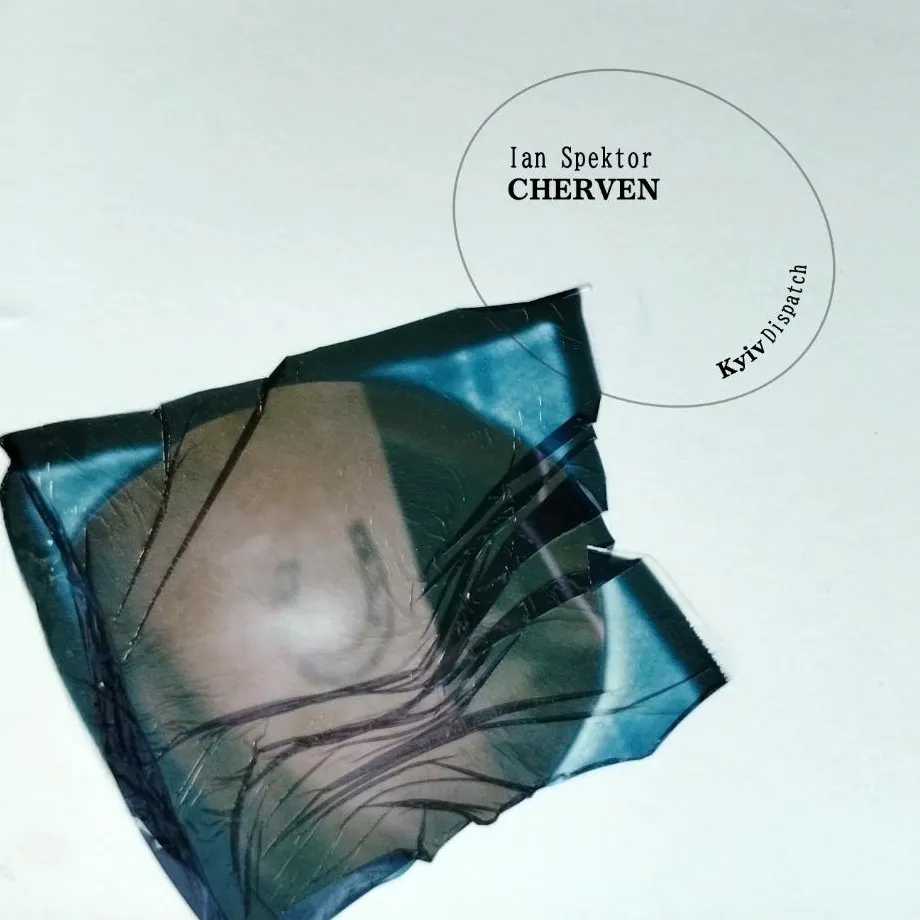
“Poignant narrative. There’s a moment during the first few minutes of ‘Cherven’ that stays with you throughout the piece, and long after”
Electronic Sound · Issue 133 · Original
Read the reviewClose
There’s a moment during the first few minutes of sound artist Ian Spektor’s 45-minute long, single track ‘Cherven’ that stays with you throughout the piece, and long after. It’s a fragment of overheard music, framed by an intense mournfulness, that occupies the middle distance. This piece is a document of war, a tapestry of field recordings made during the first year of the Russia-Ukraine conflict. We hear people talking, getting on with their lives, followed by urgent sirens, but it’s that funereal music that gives ‘Cherven’ its poignant narrative.
Electronic Sound, Issue 133 · Original
“Perhaps the only possible mode of artistic expression during total war and genocide”
Artslooker — Ivan Shelekhov · Feature · Serhii Harahulia, quoted by Ivan Shelekhov · Read the article
“A moving audio documentary on loss, memory, and daily life during the war”
Zeit-Ton, ORF — Rainer Elstner · Radio
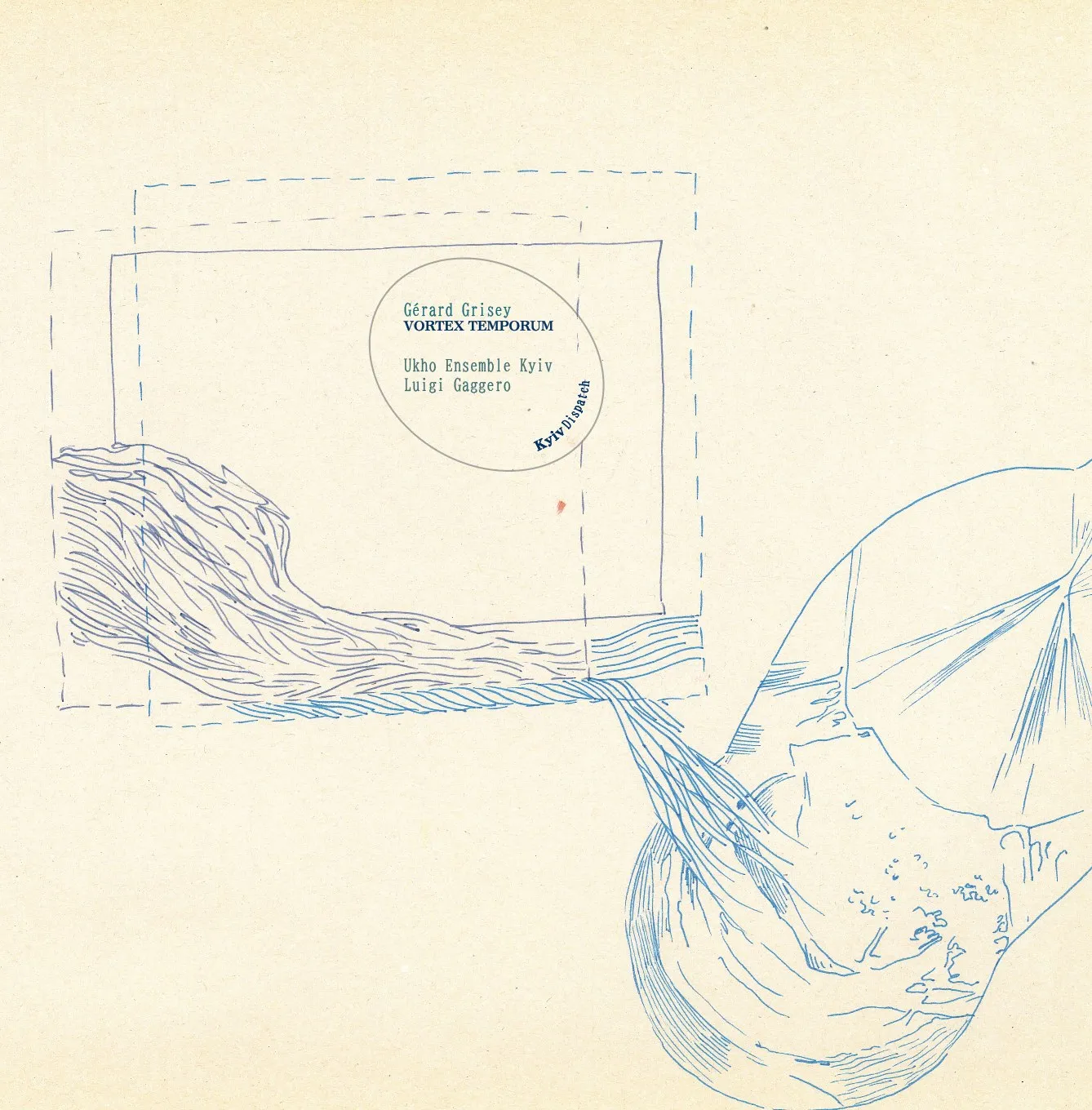
“Bold and assertive interpretation of a masterly score”
The Guardian — Andrew Clements · 9 May 2025 · Original
Read the reviewClose
Grisey: Vortex Temporum album review – bold, assertive interpretation of a masterly score
Gérard Grisey’s extraordinary expressive work, performed here by Ukraine’s leading new-music group, is one of the finest compositions of the late 20th century
Ukho Ensemble Kyiv is Ukraine’s leading new-music group, founded in 2015 by the Italian conductor Luigi Gaggero. Since the Russian invasion of the country in 2022, its members have inevitably been dispersed and its activities curtailed, but it has continued to perform a wide range of 20th and 21st-century repertories outside Ukraine. This performance of what is one of Gérard Grisey’s most important achievements, and one of the finest scores of the final decades of the last century, is taken from concerts the group gave in Stuttgart in December 2022.
Grisey completed Vortex Temporum, for two winds, three strings and piano, in 1996, two years before his shockingly sudden death. If the work that followed it, the extraordinary Quatre Chants pour Franchir le Seuil, suggested that Grisey’s music was about to enter a new phase that he did not live to explore, then Vortex Temporum is perhaps a stylistic end point, a masterly demonstration of the techniques and utterly lucid structural thinking that he had elaborated over the previous decade. What develops from a motif borrowed from Ravel’s Daphnis et Chloé into a study in how musical time unfolds at different rates generates ideas of extraordinary expressive power along the way, whether it’s the piano solo in which the opening section climaxes, the unwinding chorale of the second part or the steadily accumulating third.
The Ukho performance is bold, assertive and closely recorded, while the other easily available recording, performed by Ensemble Risognanze on the Stradivarius label, offers a different perspective, more delicate, more distant, but equally compelling; a score as masterly as Vortex Temporum can accommodate many different interpretations.
The Guardian — Andrew Clements, 9 May 2025 · Original
“In such a consistent interpretation, the piece offers a groundbreaking listening experience”
Pizzicato — Uwe Krusch · Translated from German · Original
Read the reviewClose
Whirl of Time is the translated title of Gérard Grisey’s late composition Vortex Temporum. It describes the creation of a formula of rotating and repeating arpeggios and their metamorphosis in different time fields. The work can be classified as spectral music, in which compositional decisions are based on sonographic representations, mathematical analyses of sound spectra or mathematically generated spectra.
Vortex Temporum was composed in 1994-96 for piano and five instruments. The work consists of three movements linked by short interludes. The overall harmonic picture, essentially a diminished seventh chord, is distorted with shifts of individual notes up to complete overtone rows. In the piano, four notes are tuned in scordatura. Grisey’s sense of sound dramaturgy, which is also convincing in large-scale form, is once again particularly evident here. Short interludes with air and other noises and sound shadows color the involuntary silence that arises when musicians and listeners catch their breath between two movements.
This music classic was recorded by the Ukho Ensemble Kyiv. In their playing, they make clear their intention to experience time in different ways. The three movements reflect the “time of birds, people and whales”, according to the composer. Maximum compression, then normal, i.e. human, perception of time and finally the microscopically magnified observation of details make the normally inaccessible audible. The ensemble itself lives in a war vortex that interrupts its common temporal framework and changes the daily, sensory perception of time.
The six members of the Ukho Ensemble Kyiv, which consists of up to seventeen soloists, specializes in new music under the direction of Luigi Gaggero. In Vortex Temporum, it is not only the pianist who has to master virtuoso tasks at the end of the first movement; the flautist, clarinetist and string trio are also exposed to high demands during the three quarters of an hour. Completely unimpressed by this, they take the listener on an exciting journey through auditory impressions that are more triggering than daunting. In such a consistent interpretation, the piece offers everyone a groundbreaking listening experience.
Pizzicato — Uwe Krusch · Original
“A shimmering tapestry of sound… The music unfolds here with a surging force rarely encountered in the recent history of contemporary music”
Neue Musikzeitung — Martin Hufner · 19 May 2025 · HörBar · translated from German · Original
Read the reviewClose
Ukho Ensemble Kyiv – Gérard Grisey: Vortex Temporum
Gérard Grisey's composition "Vortex Temporum" belongs to his late work and is classified as a form of "spectralism" (Wikipedia). Max Nyffeler characterized the composition as follows:
"This large-scale composition for piano and five instruments, lasting approximately 35 minutes, was written between 1994 and 1996. Here, spectral composition has reached a stage of refinement, in which individual partials, sometimes even the entire overtone series, are shifted up or down by a quarter tone, thus distorting the overall harmonic structure and creating harmonies of great complexity. In the piano, the four notes C, D-sharp, A, and F-sharp are tuned a quarter tone lower for the entire piece." (Source: Max Nyffeler – Gérard Grisey: Périodes and Vortex temporum)
The result is a shimmering tapestry of sound, creating both delicate tonal textures, reminiscent of Maurice Ravel through the instrumentation of piano quartet with clarinet and flute, and the languid, somber emptiness of the second movement. Grisey evokes an emotional depth here that immediately captivates. This is certainly true of this recording with the Ukho Ensemble Kyiv under the direction of Luigi Gaggero. It is a live recording from the Stuttgart festival "Music of the Centuries" in December 2022. The music unfolds with a surging intensity rarely found in recent contemporary music history. The second movement ends with a rush into the infinity of an unfathomable vagueness – impressive! So much vibrancy alongside and within so much horror.
Overall, this is a significantly slower interpretation than, for example, the «Risognanze Ensemble» (2007 – Stradivarius) or the «Prague Modern» ensemble (2019 – Stradivarius). In contrast, the «Ukho Ensemble Kyiv» brings the sound disturbingly close to the listener through its mixing.
The label «Kyiv Dispatch» acts here with complete aesthetic consistency, making the relevance of autonomous contemporary art accessible to a broad audience despite the Russian war of aggression against Ukraine, as was already the case with Viktoriia Vitrenko's «Limbo».
Neue Musikzeitung — Martin Hufner, 19 May 2025 · Original
“A stunning recording. Piano patterns toggle between violently jarring and serenely contemplative, bristling with microtonality while strings and winds slash, dart, and float against the shifting grain”
Bandcamp Daily — Peter Margasak · 5 June 2025 · The Best Contemporary Classical Music on Bandcamp, May 2025 · Original
Read the reviewClose
Not long after recording this late masterpiece by French spectralist Gérard Grisey in December of 2022, the members of Ukraine’s Ukho Ensemble began to scatter around the globe, the stability of its homeland shattered by Russia’s invasion. But geographic distance hasn’t halted the ensemble’s work. The situation only adds resonance to this stunning recording, in which the composer applies three different types of harmonic spectra and three different notions of time to a work rippling with dissonance and distinguished by a dramatic sense of scale in which interludes are impossibly quiet and fragile, linkages that makes us wonder if we’re hearing anything at all. The hour-long work plays with our perceptions of time, not through shifting tempo as much as the way different passages are placed; darting rapidly or slowing to a crawl, with a baseline pace in between. Grisey completed the chamber work Vortex Temporum in 1996, two years before his tragic death at age 52, and it represented a stunning highwater mark, deftly enfolding his fascination with harmonic analysis within a form teeming with vitality and tension. Piano patterns toggle between violently jarring and serenely contemplative (a la Morton Feldman), bristling with microtonality while strings and winds slash, dart, and float against the shifting grain.
Bandcamp Daily — Peter Margasak, 5 June 2025 · Original
“Luigi Gaggero leads the Ukho Ensemble in a superb rendition of the piece. One of my favorite recordings of 2025”
Sequenza21 — Christian Carey · 13 December 2025 · Original
Read the reviewClose
Ukho Ensemble Plays Grisey (LP Review)
Composer Gérard Grisey (1946-1998) employed methods that often involved magnifying seemingly small details into overarching concepts. This is particularly true of spectrographic measurements taken of single pitches, such as the low E on a trombone, which revealed a series of overtones that he would use to craft harmonic systems for a number of pieces. This spectral approach, also employed by Tristan Murail, Hugues Dufourt, James Tenney, and others, was an important feature of French music, and later that in other countries, from the 1970s onward. In the piece Vortex Temporum (1995), another element is put under the magnifying glass, a flute arpeggio taken from Daphnis et Chloé (1912) by Maurice Ravel (1875-1927). The result is a hyperintensive investigation of, as the title suggests, circular motion through time. Scored for a Pierrot ensemble – flute, clarinet, violin, viola, cello, and piano – the piece does not leave Grisey with as many of the nuances of color that a full orchestra would, but he nevertheless manages to explore myriad timbral deployments. A subtext that surely did not escape the notice of the piece’s intended audience is the fragmentation of the source material, in a sense the disassembling of a work firmly ensconced in the repertoire. Just as, in their day, the impressionists threw down a gauntlet and challenged the musical establishment, and Boulez and other members of the avant-garde did similarly with their elders, so Grisey and the other spectralists were interested in a radical reassessment of how music was to be ascertained.
Ukho Ensemble Kyiv take a deconstructive approach of their own, providing a charged, intense, and incisive rendition of Vortex Temporum. Any reference to impressionism, besides the notes and gesture of the borrowed quote, is removed from consideration. This is faithful to the score and Grisey’s musical aesthetic. Interesting to note, too, that the Pierrot ensemble signifies a connection to modernism; from Schoenberg to the present day it has been a go-to scoring for countless post-tonal composers.
While there are places in the outer movements that are quite forceful, there are also segments, such as the denouement of the first movement into the opening of the second, with a number of glissandos, where the music seems to liquefy. But a sense of conflict is never far away, as the muted clusters in the piano that support this passage suggest, and eventually the oasis of the middle movement is supplanted by intensity, led by nervous microtones and multiphonics and a crescendo of the piano’s dissonant verticals that is doubled by other members of the group. The strings also respond in kind to the clarinet’s effects, and the resultant music builds in amplitude to a hushed cadenza of descending slides, followed by a return to the first movement’s assertiveness in the final one.
This third large section expands upon the way that the Ravel quote is addressed, via fragmentation, augmentation, and interpolations of the effects that sound in the second movement. The sense of reverberation is enlarged as well, and many phrases echo instead of having clean offsets. Then, a pizzicato strings passage moves to the fore. It could be seen as a bit of sly commentary on the second movement of Ravel’s string quartet, which contains a plethora of plucked notes. This is then juxtaposed with ever more frenetic arpeggiations and glissandos, overblown wind notes, and penetrating sustained pitches. All of this underscores temporal morphing, and it is made manifest that the title serves as both a reference point and a remit for the composition. Several sections of quietude are each in turn cast aside in favor of ever more intricate sonic whirlwinds. An eventual unwinding once again stretches out the material, with explosive interruptions keeping the intensity level at a peak. Hushed moments then crosscut with vicious attacks and fluctuating lines, and a long tremolando creates a dynamic hairpin. What ensues in its wake is reflective, with breathy woodwinds, sustained strings, and a tolling repeated note from inside the piano in a decrescendo to silence.
Vortex Temporum is a late piece in Grisey’s catalog. He died in 1998, at age 52, of a brain aneurysm. It fulfils a number of the objectives he set out to explore, both from technical and philosophical vantage points. Luigi Gaggero leads the Ukho Ensemble in a superb rendition of the piece. It is one of my favorite recordings of 2025.
Sequenza21 — Christian Carey, 13 December 2025 · Original
“Music that seems to fall outside the fluidity of time itself, as Grisey intended”
Luminous Dash — Patrick Bruneel · 12 May 2025 · Translated from Dutch · Original
Read the reviewClose
At our house, we have quite the habit of having a big breakfast on Sunday mornings—roughly around midday, actually. That includes freshly squeezed orange juice, an egg, bacon, a croissant, and a few other things. Jazzy or classical music, or a record full of hits from the good old days, usually forms the musical background. However, we prefer to play what the Ukho Ensemble Kyiv is presenting here at a different time.
The music we are about to hear is certainly not for the faint of heart. The ensemble, based in Kyiv, Ukraine—and therefore on hold due to the war of that Russian buffoon—is an arrangement of a composition by Gerard Grisey called Vortex Temporum. The piece was composed with the war in mind, history that may or may not repeat itself or be changed by yet another ruler, and at the same time questions or attempts to understand the so-called fluidity of time. The Italian conductor Luigi Gaggero expertly leads the piece, which was written by Grisey between 1994 and 1996, not long before his death in 1998.
Grisey is considered the founder of so-called spectralism, an attempt within modern classical music to move away from the work of, for example, Webern, Schoenberg, Boulez, and Messiaen, while simultaneously incorporating influences and points of contact with Gavin Bryars. While Grisey may be somewhat indebted to these great names in the contemporary classical world, he nevertheless manages to find his own way and leave his own mark.
It is music that dares to step outside expected patterns, that dares to tread other paths, and that does not shy away from challenging the listener, catching them off guard, and overwhelming them. The ensemble itself has been playing the piece for a long time, as has the conductor, for that matter, so that the recordings we hear here, dating from 2022, have become, as it were, the crystallized, virtually final version of the work.
Whether it is jazz or classical, free improvisation or avant-garde, it does not matter so much. It is timeless, music that falls, as it were, outside the fluidity of time itself, as Grisey intended.
Luminous Dash — Patrick Bruneel, 12 May 2025 · Original
“Inhabiting this complex work, the ensemble sustains its sonic energy and brings out every subtlety of the writing”
ResMusica — Michèle Tosi · 22 April 2025 · Album of the month, April 2025 · translated from French · Original
Read the reviewClose
In the vertigo of time with Gérard Grisey and Ukho Ensemble Kyiv
Founded in 2015 by conductor Luigi Gaggero, the Ukho Ensemble Kyiv has distinguished itself through numerous recordings and monographs of contemporary composers. The vinyl release of Gérard Grisey's Vortex temporum is a major event on the Ukrainian experimental label Kyiv Dispatch.
Gérard Grisey's Vortex temporum (Whirlwind of Time), composed between 1993 and 1995, originates from a formula of swirling arpeggios (a tribute to Ravel and his ballet Daphnis and Cloe) repeated and transformed through different temporal fields corresponding to the three movements of the piece: ordinary (1), more or less dilated (2), more or less contracted (3). Four notes in the middle register of the keyboard are tuned a quarter tone lower for better integration with the microtonal textures of the other instruments: flute, clarinet, and string trio.
In the first movement, dedicated to Gérard Zinsstag, the tension is maintained flawlessly throughout, and great care is given to textures, never breaking the taut thread between the opening arpeggio and its subsequent transformation. The now-legendary piano cadenza that closes the first movement, as powerful as it is virtuosic, resonates under the fingers of the performer (Dina Pysarenko) with a fluidity of touch and an understanding of the score that are utterly convincing. Noise interludes, intended to "fill this space of waiting" (in Grisey's words), are heard between each movement, a way of remaining within the musical continuum that the composer envisioned.
Dedicated to Salvatore Sciarrino, the second movement, in an expanded timescale (“spectral time of sleep rhythms,” Grisey specifies), is skillfully executed. The slow progression of piano chords, gliding from high to low, traces the trajectory beneath the fragile and unstable textures of the other instruments. Diffracted within the instrumental space, the swirling initial arpeggio returns in the third movement (dedicated to Helmut Lachenmann), which the composer stretches and filters to the very limits of audibility. Colors fade and vertiginous silences linger in a liminal music to which the performers of the Ukho Ensemble lend a singular character, possessed by this complex work whose sonic energy they sustain and whose every subtlety of writing they bring to life.
ResMusica — Michèle Tosi, 22 April 2025 · Original
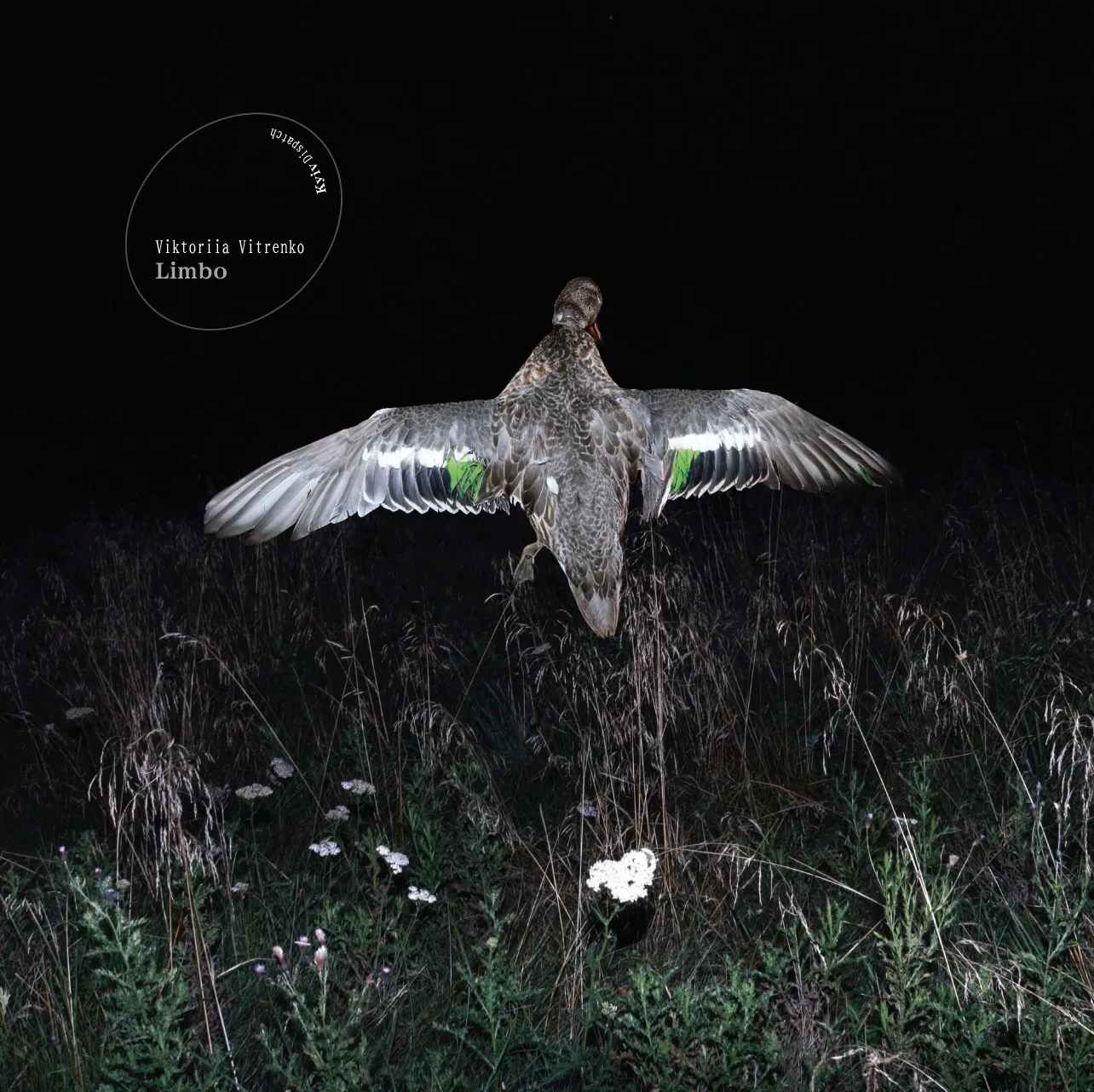
“The listening experience is cathartic”
Frankfurter Allgemeine Zeitung — Yelisaveta Landenberger · Translated from German · Original
Read the reviewClose
Singing of Pain: Viktoriia Vitrenko and Songs from Ukraine
Following a few piano notes that establish an irregular rhythm, a soprano voice—at once gentle and restless—enters, humming a wordless melody. Together with the metallic, percussive accompaniment of a prepared piano, this creates a mysterious, almost nightmarish atmosphere. From this backdrop, a beautiful voice emerges across three songs composed by the Polish artist Agata Zubel. In the final piece, the initial hesitancy shifts into a stifled, desperate cry of rage. "Limbo"—a place where souls linger in hope of redemption, trapped between heaven and hell— lends its name to the debut solo album by Ukrainian soprano and composer Viktoriia Vitrenko. “Limbo” will be released digitally on April 2nd and is already available as a double LP via the label "Kyiv Dispatch," which publishes experimental and contemporary classical music from Ukraine. The 18-track album is dedicated to Vitrenko’s friend and colleague, the Belarusian opposition figure Maria Kalesnikava—a professional flautist who is currently serving an eleven-year prison sentence under inhumane conditions for her role in the 2020 protest movement. Reports have since emerged detailing her dire state of health.
“Limbo” was first presented in February 2022—shortly before the full-scale invasion began—at the Eclat Festival for New Music in Stuttgart; a time when the COVID-19 pandemic was still ongoing, while the threat of a major war seemed increasingly inevitable. Even when the musician recorded the album later in August 2022 at a studio in the Kyiv region, she remained surrounded by uncertainty—a state that persists to this day. Her voice, accompanied by her own piano playing, conveys this with haunting intensity.
Following the opening pieces by Zubel is the cycle "Signs of Presence" by composer Alla Zagaykevych, which draws upon poems by Iya Kiva. The poet had been forced to flee Donetsk as early as 2014, due to the onset of Russian aggression. Her verses, written in Ukrainian, lament the loss of a homeland; stylistically, the songs elegantly bridge the gap between contemporary classical music and folklore. In the third and final piece of the Zagaykevych cycle, Vitrenko’s singing transcends its boundaries, evolving into a desperate lament that seems to verge on madness.
With her two "Illuminations" tracks, Chinese composer Ying Wang contributes the only portion of the album that incorporates electronics alongside voice and piano. Here, Vitrenko—speaking in English—first recites the words of dissident publisher Geng Xiaonan, delivered in court, and subsequently uses a megaphone to broadcast a message from the charismatic Maria Kalesnikova, originally addressed to protesters in Belarus in 2020: "We are peaceful, we are honest, we want to live in a safe and free country. We are ready to fight for this." These simple yet forceful words, repeated several times by Vitrenko, leave a lasting impression.
"Simple Songs and Songs of Pining", composed for her by Sven-Ingo Koch, sound both elegant and off-kilter; they are settings of poems by Jan Wagner.
The album concludes with the tranquil "Songs of Holy Fools" by Maxim Shalygin—composed back in 2009 and 2010—which are the only pieces on the record not commissioned by Vitrenko. He wrote them during his relocation from Ukraine to the Netherlands. One of the five songs is based on the poem "Tender-delicate" (*Zärtlicher-zart*) by Osip Mandelstam, while the others draw on Shalygin’s own verse; all are in Russian.
With "Limbo," Vitrenko presents a creative debut album, remarkable for its stylistic diversity. She has succeeded in distilling the recent years—marked by war, resistance, and repression—along with the emotions they evoked, into art. The listening experience is cathartic. In May, the musician will present her album anew as an audiovisual installation at the Frequenz Festival in Kiel.
Frankfurter Allgemeine Zeitung — Yelisaveta Landenberger · Original
“A new artistic form emerges, establishing self-accompanied singing as a genre in its own right within contemporary music”
Positionen — Saori Kanemaki · No. 145 · Original
Read the reviewClose
On her debut album LIMBO, Viktoriia Vitrenko demonstrates both her range as an interpreter of contemporary vocal music with piano accompaniment and her ambitious curatorial vision. A new artistic form emerges from the post-production of a theatre project, establishing self-accompanied singing as a genre in its own right within contemporary music.
Positionen — Saori Kanemaki, No. 145 · Original
“A powerful artistic response to isolation, trauma, and political injustice”
Brooklyn Rail — Ondrej Veselý · Interview · September 2025 · Original
Read the interviewClose
In conversation: Viktoriia Vitrenko with Ondrej Veselý
In dangerous, reactionary, confusing times, Ukrainian soprano, conductor, and curator Viktoriia Vitrenko stands out as one of the leading voices of her generation in European contemporary music. Praised for her clear, pure voice and profound expressivity, she has received international acclaim, including nominations for the German Record Critics Award and the International Contemporary Music Awards. Her debut album György Kurtág: Scenes (Audite, 2019) featured chamber music by György Kurtág. At the beginning of this year, Vitrenko released her first solo album, Limbo (Kyiv Dispatch)—dedicated to Belarusian musician and activist Maria Kalesnikava— a powerful artistic response to isolation, trauma, and political injustice, featuring vocal cycles from a compelling selection of contemporary composers includes Agata Zubel, Alla Zagaykevych, Ying Wang, Sven-Ingo Koch, and Maxim Shalygin. Vitrenko sings and accompanies herself on piano.
I discovered Limbo quite by chance when I heard a fragment of Shalygin’s songs, and I was instantly hooked by the sound and aesthetics. As I listened further, I found myself immersed in sensations and emotions that I hadn’t experienced in contemporary music for a long time. This album is powerful and penetrating, speaking deeply to the core. It evokes a subtle charm of romanticism, but within the context of contemporary sound—as an internalized feeling of the individual, whether artist or audience. In my conversation with Vitrenko, she reflected on the role of art in times of crisis, the emotional and physical challenges of performing under extreme conditions, and the complex ethical questions surrounding cultural expression in the shadow of war.
Limbo explores themes of isolation and injustice and is dedicated to Maria Kalesnikava, who is currently imprisoned for opposing Belarus’s regime. What inspired this project?
It was conceived during the pandemic, in 2021, when I was sitting in my room during lockdown and couldn’t practice my singing or playing. My neighbors banged on the wall every time I started; it was a depressing state that created a lot of psychological pressure. When music is your life and someone takes it away from you, you feel trapped inside your own walls. You’re alive, but you’re not living your life; you’re allowed to exist, but not to exercise your needs or freedom.
My idea was to project the same kind of in-between state onto the imprisonment of Maria Kalesnikava. At that time, she was already in a prison in Minsk under investigation which, of course, was completely fabricated. A third reason for the project was the looming question of whether Russia will invade Ukraine. From that perspective, this kind of liminal space—of uncertainty, of being in between—made me feel it was the right time to develop the project.
Limbo addresses painful and complex themes. How did you translate these emotions into an artistic expression/project?
I introduced the idea to Christine Fischer from the New Music Festival ECLAT, who had worked with Maria before. We developed the concept as a staged performance. But I always knew the music itself was strong enough to be presented without staging. It’s a unique format in contemporary music—I haven’t seen anyone else do it. Throughout, I kept asking myself, how can I portray this in-between state, this loneliness and isolation? It was clear—I had to be the sole performer. Being a conductor implies a background in piano, so the singer-songwriter idea came naturally. Then I asked myself, can complex contemporary music sound not complex, but very approachable? Out of this thinking, the format emerged: a singer-songwriter framework within contemporary music.
The selection of composers was a crucial decision for such a project…
I immediately thought of Alla Zagaykevych, with whom I had previously worked, to commission pieces addressing the Russian invasion of Ukraine. I loved her idea to use poems by Donetsk poet Iya Kiva, who has lived in a state of limbo since 2014 [Editor’s note: In 2014, an armed conflict erupted in Donetsk when pro-Russian separatists declared independence, leading to the ongoing war in Eastern Ukraine]. Next, I invited Polish composer and singer Agata Zubel, knowing she would craft beautiful vocal lines essential for this project. Then my friend Maxim Shalygin introduced me to his vocal cycle Songs of Holy Fools, which I premiered in its original singer-songwriter form. I also included German composer Sven-Ingo Koch, whose songs I admire, especially those featuring poems by Jan Wagner.
Finally, Christine Fischer suggested Ying Wang for the stage performance. I wanted a diverse song cycle with different aesthetics and a performative piece to avoid being behind the piano all the time. Ying’s father, Wang Xilin, was imprisoned in China for his cultural opposition to the regime, which fits deeply into the project’s themes of political injustice and human suffering.
Liminality, which is the overarching theme of Limbo, represents personal, cultural, or aesthetic transition. Given the profound trauma caused by the Russian invasion of Ukraine and ongoing war, has your experience of liminality created space for healing?
As an artist and musician, my purpose is to create a space where you can individually and very openly express yourself—be it trauma, a scream, opposition, or simply your reaction to reality. I don't think it literally helps me heal all my trauma, but it helps me to process this difficult situation. This anxiety has been ongoing since summer 2020 and is not only related to Ukraine.
Does it change your perception of musical time, and does accompanying yourself on the piano intensify the emotions you convey on stage?
I thought a lot about the emotional side—how would I feel this isolation, emptiness, and vulnerability—because this program is very much about vulnerability, about allowing myself to fail on stage while completely alone. For me, that is the highest truth an artist can offer, especially compared to classical music, where everything must be perfect. This led me to ask myself, how can we respond differently when we are dying inside, screaming, or collapsing? Perfect sounds won’t convey that.
It remains vital for me to show this vulnerability on stage because the program lasts over an hour, with just me singing and playing piano, sometimes using extreme vocal techniques or quasi-folk screaming from Ukraine. It’s an intensely emotional performance, and maintaining the same level of control throughout is challenging. As I said, it would be untrue to act as if nothing were happening, to myself, my body, my voice. The voice, as an instrument, is the truest reflection of emotion. I’m not saying I fail every time, but I’m always on a fragile fringe, close to collapsing. When recording this album, I collapsed on the fifth day. At that moment, I thought I couldn’t continue. The recording took place near Kyiv, with daily commutes through Irpin and Bucha. I saw corroded cars, ruined homes, emptiness, and isolation. That’s when I realized this was exactly what I needed to convey. If I collapsed or failed, I wanted the audience to feel it in the recording.
Just a few years ago, we could hardly imagine that basic certainties once taken for granted would be so deeply shaken. Despite this fragility, I notice some young people distancing themselves from political realities, perhaps hoping the challenges will pass. How do you see the relationship between art and politics today?
That’s a valid question, and not just for the younger generation. I see this even among people my own age. Many German artists focus on issues like gender, LGBTQ+ rights, and democracy, which are important and shouldn’t be disregarded. Still, everyone has the right to remain silent… But when you face certain issues firsthand and feel compelled to express your opposition or opinion, art becomes the right medium, the right space to do so. I believe art creates a safe space, even when expressing political views publicly. In this sense, it is both an opportunity and, to some extent, an obligation—if one feels compelled—to bring these topics closer to those who might not otherwise engage with them.
Today, a common reaction to the ongoing attack on Ukraine is a general ban on Russian art. Many radio stations and festivals no longer feature Russian works. On one hand, this is understandable—there’s reluctance to promote representatives of Russian culture. On the other hand, history shows that collective guilt has often led to unfortunate decisions. I’m not entirely sure what the right approach is. How do you personally view the idea of a blanket ban on Russian music at festivals and public programs?
This is a very difficult and painful question. As a Ukrainian, I support a complete ban on Russian music and art because excluding these works from international programs creates space for Ukrainian culture, or any other culture that has been systematically ignored by Western programmers. This opportunity to showcase Ukrainian culture means more to me than the ban itself. It allows greater reach and awareness of Ukraine’s rich cultural heritage, increased collaboration for Ukrainian artists, and enhanced visibility of Ukrainian art. I strongly believe that consistently integrating Ukrainian compositions into regular programming, not just as exotic or supplementary additions, will ensure their lasting presence beyond the context of this war. At the same time, having lived in Germany for thirteen years, I have friends who left Russia years ago for political reasons. They support Ukraine, donate money, and host refugees. They are empathetic and understand the historical situation. It’s hard to turn your back on them just because they haven’t renounced their citizenship. Recently, I watched a discussion between the head of the Ukrainian Institute and a renowned Ukrainian author about the ban on Russian culture. Many arguments were made, but ultimately it seems impossible to fully ban Russian culture from festivals and venues, even temporarily. So, a change in approach is necessary. For me, the focus is on creating greater visibility for Ukrainian musicians and composers, especially female artists, and supporting other Ukrainian creatives in the best way I can.
Do you have any contact with Maria Kalesnikava? Does the Belarusian regime allow any form of correspondence?
No! I know she never received my letters. The regime claims she doesn’t want to see anyone, which is obviously false. Very recently, in November, her father was finally allowed to visit her. But for a year and a half, she was completely cut off, no one even knew if she was still alive. So unfortunately, no, we are not in contact, and she is not allowed to receive any correspondence.
Brooklyn Rail — Ondrej Veselý, September 2025 · Original
“Each of the five compositions finds a virtuosic, selfless response in Vitrenko’s performance”
Neue Musikzeitung — Martin Hufner · 22 April 2025 · HörBar · translated from German · Original
Read the reviewClose
Viktoriia Vitrenko: Limbo
Ukrainian singer and conductor Viktoriia Vitrenko has released the double vinyl album LIMBO on Kyiv Dispatch, a new Ukrainian label dedicated to experimental and contemporary classical music. It's a diverse mix of compositions for piano and voice, but what's truly "diverse" are the approaches taken to the compositions and their unique sound. Five composers (Agata Zubel, Alla Zagaykevych, Ying Wang, Sven-Ingo Koch, and Maxim Shalygin) contribute to this.
The album begins with repeated notes on a prepared piano. They are single strokes with pauses for decay before the voice enters. Viktoriia Vitrenko is responsible for both here, as on the entire album. It all emanates from one body. And this creates, from the very first note (sound), a very special connection and presence that one cannot and does not want to escape. Zubel's composition is as much eloquent as it is silent. And in the third piece, it is very painful. One simply has to let it wash over you; the initially almost meditative exercise ends aggressively, oppressively, heavily.
It's important to know: "LIMBO is a journey through uncertainty and a very personal project that grapples with the stagnation of waiting. It is dedicated to Vitrenko's friend and colleague, the flautist and political activist Maria Kalesnikava, who is serving an eleven-year prison sentence in Belarus for her participation in the 2020 protests." This is an understatement, as if Maria Kalesnikava's sentence were handed down within the framework of due process. It is a totalitarian punishment and an attempt at state intimidation and torture.
Vitrenko's album as a whole engages with the overall theme. Each of the five compositions finds a virtuosic, selfless echo in Vitrenko's performance, thus becoming a rare testament to successful politically charged engagement in these broken times. Rashad Becker's mixing reflects all of this and elevates the inherently thematic "singer-songwriter" setting to an additional acoustic dimension. This is particularly evident in Ying Wang's "Illuminations." Impressive, unsettling, but also liberating!
The two compositions by Maxim Shalgygin and Sven-Ingo Koch are more in the realm of the piano song tradition, which, in the overall context, nevertheless creates a new kind of listening experience. Shalgygin's restraint, chronologically speaking, stems from the time of what Viktoriia Vitrenko calls "purgatory." In Sven-Ingo Koch's "Simple Songs & Songs of Pining," the doors to the most delicate vocal nuances open, and, as in "Marder," expressiveness and bottomless oscillations blend together—what challenges!
The album was released by Kyiv Dispatch. That, too, is an impossibility in these times, and therefore all the more valuable.
Even despair needs expression. Even perseverance and courage need a voice. Even in dark times, we need art, and music and performance that sometimes burst through the crack of hope and open doors. Viktoriia Vitrenko and her presentation of the five compositions achieve this with a friendly yet assertive, almost masterful touch.
Neue Musikzeitung — Martin Hufner, 22 April 2025 · Original
“The most striking moments come when the voice seems to dissolve into the sound of the piano or electronics”
The Claquers — Oleksandra Chebotar · Translated from Ukrainian · Original
Read the reviewClose
Viktoriia Vitrenko’s Limbo: A Diary from the In-Between
learning to look for the roots of life which still doesn’t know what to call itself — Iya Kiva
In early April, Limbo, the album by Viktoriia Vitrenko, an acclaimed singer and performer specialising in new vocal music, became available to stream online. She performs regularly: think of the May performance of Pierrot lunaire, interrupted by an air raid alert, the autumn concert of new music Artifacts of Voice, and her recent performance of a cycle by Sviatoslav Lunyov at the National Philharmonic. She also gives lectures and works with record labels. Last year, Vitrenko recorded works by Valentin Silvestrov for Sony Classical, and in 2019 she recorded chamber works by György Kurtág for AUDITE.
Now she has presented her first solo release, Limbo, on Kyiv Dispatch. It is a solo album in every sense: Vitrenko sings and plays piano, conceived the project, and took the initiative in having most of its works written.
The album was presented in late February in a series of lecture performances in Lviv, Kharkiv, Odesa, Dnipro and Kyiv. Vitrenko performed excerpts, explained the concept and discussed the vocal techniques she used. These concerts were also encounters in which listeners could get a sense of what Limbo is and come to understand it.
Concept
Limbo explores uncertainty and waiting in depth. It is a multifaceted installation that brings together a staged musical performance, a recital and video. Vitrenko seeks to create a space of uncertainty and searching that evokes a state between reality and illusion. At the presentation, she explains that limbo is a place of transformation where people can explore what they feel and experience.
The album features works by five composers: Agata Zubel, Alla Zagaykevych, Ying Wang, Sven-Ingo Koch and Maxim Shalygin. Its concept is deeply personal and has a social dimension. Limbo grew out of events that have defined our time. Work on the project began in spring 2021, when the world was poised between uncertainty and anticipation, between protest and repression, between the struggle for freedom and its temporary loss.
“I developed this project while on a residency in Paris. I was working out its themes, drafting texts and trying to find a way to express how I felt about the pandemic. Paris was in full lockdown. You couldn’t go outside after eight in the evening, and the city was dead. This imposed isolation, being forced to stay within four walls, happened just as everything outside was coming into bloom and nature was going on with its own life. It also had to do with my sense of the physical isolation of my friend Maria Kalesnikava [a Belarusian flautist and political figure — ed.], who was sentenced to eleven years in a Belarusian prison for taking part in protests,” Vitrenko said.
After the full-scale invasion began, Vitrenko decided to come to Ukraine to record the album. “I knew I had to record this music in that state of being ‘here and now’. Musically, it gives you a completely different sense of time and space.”
Structure
In Agata Zubel’s 3 Songs, Vitrenko sings with her mouth closed for nearly fifteen minutes. It is an image of a voice someone is trying to take away in every sense: physical, psychological, political and cultural. The sound seems to push through obstacles in an effort to break free. The piano, prepared with magnets, gives a sound to the system of tyranny embodied by the solitary confinement cell.
In discussing the cycle, Vitrenko stressed the importance of the Slovenian philosopher Mladen Dolar’s ideas in A Voice and Nothing More. For Dolar, the voice is precisely that “nothing more”: something distinct from words, meaning and pure sound, yet crucial to human subjectivity. Next comes Alla Zagaykevych’s Signs of Presence, set to poems by Iya Kiva. Zagaykevych combines a soft whisper and Sprechgesang, which give way to an imitation of traditional Ukrainian singing. “Alla Zagaykevych and I are friends and collaborators,” says Vitrenko. “In the Ukrainian context, her work touches on the subjects I wanted to talk about. She has also always taken a clear political stance, which was very important to the project.”
The urge to defend one’s identity when every effort is being made to take it away comes through most vividly in the third song. Harsh, uncomfortable grunts keep interrupting the singing, as if someone were literally strangling the performer as she sings. The words, too, take on a symbolic force:
to hold the needle of silence in your mouth to stitch words together with white thread to shrink back, choking on your own spit to spit up blood instead of screaming to hold back the moisture of speech on a tongue full of holes like a rusted bucket
Ying Wang’s pieces, with their pop aesthetic, rap rhythms and R&B, are the biggest surprise on the album. The first of the two tracks chants a text from the trial of the Chinese dissident whose name gives Nan its title. The second is, in Vitrenko’s words, “a dance collage that expresses the euphoria of seeing a crowd out in the streets during a protest”. The protest in question is the 2020 uprising in Belarus, a connection made explicit by the use of Maria Kalesnikava’s words.
Sven-Ingo Koch was the first person Vitrenko invited to join the project. “I’d always been drawn to his music. He showed me a song he was working on for German national radio, for a radio play by Jan Wagner. Wagner also contributed to our album, writing a poem especially for it. I loved the aesthetic and realised it was exactly what I’d been looking for,” Vitrenko recalls.
After the whispers, moans, pitched speech and chanting of the earlier pieces, Koch’s Simple Songs & Songs of Pining brings us to bel canto. Beauty or relief is scarcely the point here. Take the fourth song, the seemingly meditative “Vogelgrabsong”, whose words dwell on which bird will get which part of a human body. The last song has the air of a cabaret number, with a jaunty, awkward vocal melody and a colourful accompaniment. It is a meditation on death. The speaker likens human life to a burning match and simply ceases to exist physically. At the end, the music does much the same: it arrives nowhere and simply disappears.
In Maxim Shalygin’s Songs of Holy Fools, the voice becomes detached and disembodied. Gradually it seems to dissolve into the ether, vanishing in time and space. The works also open up a painful discussion. Shalygin wrote the Russian-language poems for all but the second song in the cycle, which sets a poem by Osip Mandelstam, also in Russian.
The decision to include this cycle now evokes mixed feelings. It sits uneasily with the reality in which Ukrainians face the consequences of Russian aggression every day. At a time when language has become a marker of identity and resistance, the choice seems problematic, to say the least. Vitrenko approaches the music through a postcolonial lens: “Russian was the language Maria [Kalesnikava — O. Ch.] and I spoke to each other. It was our shared colonial inheritance. There’s something like a requiem for identity in Shalygin’s texts. Those texts struck very close to home for me.”
Reflection
Limbo explores states any of us might find ourselves in: uncertainty, isolation, waiting, fear and hope. It is a kind of diary from the in-between, where the past has already been let go and the future has yet to arrive. From the first sounds, the music becomes a space that absorbs you. Time ceases to exist. You’re left waiting, as though suspended between two states. Some passages stir anxiety, others a desperate urge to break free, and others still the peace that comes at the end of a long and difficult journey.
The most striking moments come when the voice seems to dissolve into the sound of the piano or electronics. In Zubel’s third song, anguished moans merge completely with the chaotic piano accompaniment. At moments like this, you marvel that Vitrenko can play and “sing” at the same time. The same technique has the opposite effect at the end of Koch’s first song. It feels like drifting off to sleep or slipping into memories that vanish the moment you try to hold on to them. Limbo offers questions that stay with you. What does it mean to be between two states? What does waiting feel like? Can we hold on to a moment before it disappears? The album is about the limbo within each of us, about personal stories of loss and hope. Perhaps its power lies in the way it echoes in anyone willing to listen.
The Claquers — Oleksandra Chebotar · Original
On the Edge of Limbo: Sasha Andrusyk and Elena Subach on the Photographs for Viktoriia Vitrenko’s LIMBO
Artslooker — Amina Ahmed · Feature · Read the article
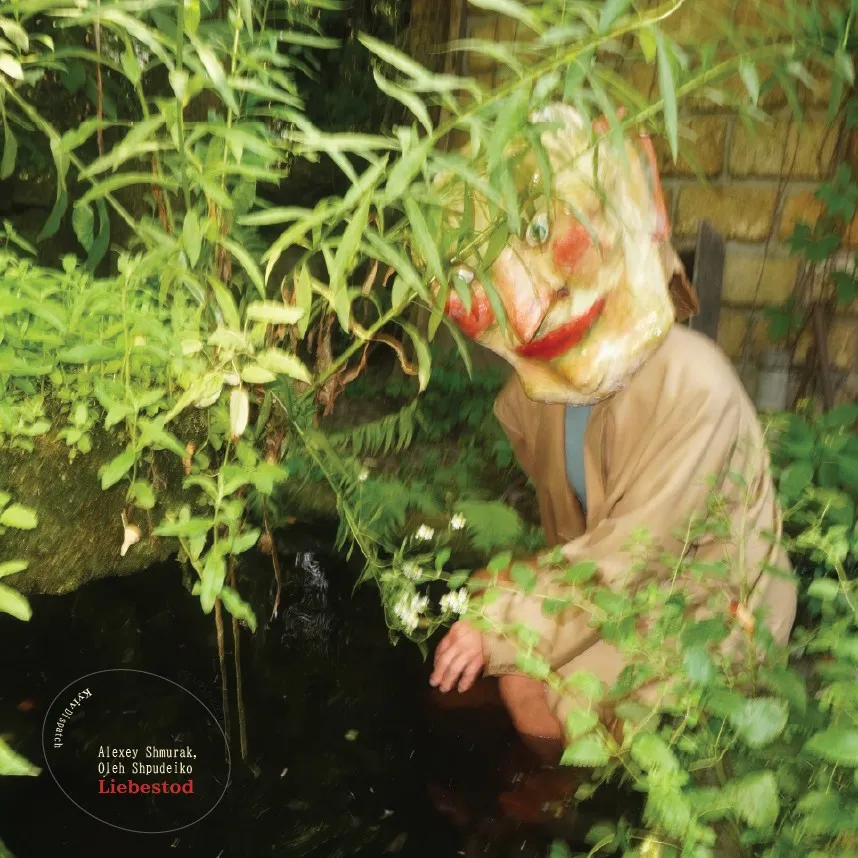
“Contrasting ideas about musical styles, moods, and languages collide and merge into something uniquely new”
taz — Yelizaveta Landenberger · 2 May 2025 · Translated from German · Original
Read the reviewClose
Drones, tears, and love-death
Music from Ukraine is experimental, stylistically diverse, and defies the precarious situation of war. An overview of exciting new albums.
"My heart, my rosebud!" a slightly off-key voice sings in Ukrainian, accompanied by a melancholic piano melody. "It breaks my heart that you're going far away from me, and I can't..."
The words are taken from a love letter written by the Cossack Hetman Ivan Mazepa to his much younger lover. Instead of further words, whistling begins, seemingly isolated, disjointed whistles; and the voice emits sometimes cheerful "Lalalas," sometimes powerful, almost aggressive "Param Params," embedded in a kitschy love song hook. Finally, the song, lasting over ten minutes, evolves into contemporary dance music, augmented by electronic beats.
This is "Heartily," the first of four tracks on the recently released album "Liebestod" by composers and musicians Alexey Shmurak and Oleh Shpudeiko, available both physically on vinyl and digitally. It is also the very first release from the experimental music label "Kyiv Dispatch."
Shpudeiko, who now lives in Germany, is known under his stage name Heinali for his idiosyncratic electronic compositions that employ medieval polyphony. His solo album "Kyiv Eternal" (2023), for which he used field recordings from the pre-war Ukrainian capital, also garnered international attention. Shmurak still lives and works in Kyiv as a classically trained composer and pianist, having studied at the conservatory. He now works experimentally, primarily using acoustic instruments. As can be clearly heard in the track "Heartily," he also frequently uses irony as a stylistic device.
On their duo album, contrasting ideas about musical styles, moods, and languages collide and merge into something uniquely new. The album title alludes to the motif from Richard Wagner's opera "Tristan und Isolde"—the love of the two protagonists is impossible in this life, and so they can only be together in death. However, there are no direct musical references to Wagner, Shpudeiko explains to the taz newspaper. "It's an abstract idea that unites all the songs on the album.”
The ambivalent mood between exuberant love and a longing for death, a mixture of extreme emotions in uncertain times, defines the sound of the entire album. Shpudeiko is responsible for the electronics, while Shmurak sings, plays piano, harpsichord, and MIDI keyboard.
In addition to Mazepa's words, the album also includes poems by the Ukrainian poet Volodymyr Svidzinsky, who, like many other Ukrainian cultural figures, was murdered in 1941 during the Stalinist repressions. Verses by the Romantic British poet John Keats are also quoted.
Shmurak told taz that six months before the start of the Russian invasion, he and Shpudeiko were approached by label founder Sasha Andrusyk about recording an album together. Work began in Kyiv in the summer of 2021, and the music was completed after the outbreak of war.
taz — Yelizaveta Landenberger, 2 May 2025 · Original